Please access both links and blog.
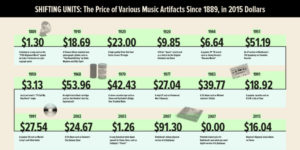
(1) How Much Is Music Really Worth?
http://pitchfork.com/features/article/9628-how-much-is-music-really-worth/
(2) Global Report 2018

Course Readings: Introduction to the Music Industry | Fall 2018
Dr. Stan Renard
Please access both links and blog.
(1) How Much Is Music Really Worth?
http://pitchfork.com/features/article/9628-how-much-is-music-really-worth/
(2) Global Report 2018
Comments are closed.
Both articles express very contradicting sentiments about how streaming services and the continued development of music technology has effected the revenue to artists over time. A good point in article one is how the “units” have continuously changed over time from per album, per track, per stream, and so much more because of the constant changes in music and this has a major negative affect on how much artists get back. In contrast article 2 combats that with details and a clear chart on how while artists have started asking less from physical copies of their music the revenue has adjusted as streaming music gains popularity and readjusts music revenue slowly raising it to the old “normal” standards. Different sources hold such varying values to the prominence of streaming music sources in adding to revenue because people forget that those who don’t pay are still getting money back to the performers through ads. But exactly how much money do these streaming services gain from advertisements? Is it comparable to the relatively low prices listeners pay to get unlimited music every month? After researching I discovered a phrase known as the “value gap”.
Here’s an article that touches on the value gap.
https://www.techdirt.com/articles/20160803/15263735147/ridiculous-concept-value-gap-music-services-how-it-could-harm-both-tech-industry-music-industry.shtml
The second article emphasized how streaming has brought success to the music industry; something I don’t think many people expected when it first emerged as a platform. I had always thought that streaming had very little value to the people trying to make money, but this article illustrates that it’s the opposite. The article also made me think about the value of the content provided on streaming platforms. There has been a recent rise in original content produced by platforms such as Amazon and Netflix, and there are also a number of artists who are gaining popularity solely through putting their content on platforms like Spotify (ex Chance the Rapper). This brought to my mind the amendment that the Grammy’s made to their rule that previously outlawed streaming-only content from being considered for awards. It seems that the popularity of music streaming is helping create validity for the artists who choose to use that as their primary distribution source.
Here’s an article on the Grammy’s decision to begin allowing streaming-only content to be considered for awards.
https://www.grammy.com/grammys/news/streaming-only-recordings-now-grammy-eligible
The Pitchfork article and the Billboard article both highlight the fact that streaming has brought an increase in revenue. But the Pitchfork author gives us a much more analytical view of the music industry. Noting that while streaming has brought an increase in revenue, the economic value of music has in fact gone down. But as an artist, I was drawn to the emotional opinions of the article first, and the factual commentary second.
The author highlights that music has both a monetary and emotional value. Perhaps the reasons for the economic decline is a consequence of an artistic decline within the industry. In the article the author states, “but ultimately music and business, though inextricable from each other, aren’t the same.” I believe this quote says it all. The music industry is too concerned with making money and forgets that from the very beginning of human existence, we have relished in the creation of music.
I attached an article from MusicClout.com which suggests 10 alternate reasons for the loss in revenue. This may not be directly related, but in order to find out why the music industry is losing revenue, I think we must also look at how music has changed. The art affects the business and the business affects the art.
https://www.musicclout.com/contents/article-244-top-10-reasons-why-the-music-industry-is-failing.aspx
Something that sparked my interest in the first article was the reference of the iTunes download store and Spotify and how they were marked “saviors” (despite their lack of success in this regard). I wondered whether or not said applications made it harder or easier for artists to get discovered, and what effect other apps, like Soundcloud, have made on the industry. These websites make it easier than ever to put out new music for the world to see, but at what point is there too much music?
Since there is no way to quantify how easy or hard it is to be a hit sensation, I researched the process of releasing music through Soundcloud. New users simply have to create a profile to which their art will be linked, and are then free to upload to their heart’s content.
Next in my research, I looked up just how many songs have been uploaded on Soundcloud. According to The Verge, there are an estimated 125 million songs uploaded, with about 110 million being free, user uploaded files. Granted, not all of these are originals or are intended to venture anywhere beyond the listening confines of an orange app. However, the addition of thousands of new songs each day on this app alone makes it seemingly impossible to stand out from all of the clutter.
There are several different factors that come into play here, such as the topic of whether or not a signed contract with a record label is even needed anymore, or if getting signed is even the end goal for these artists. The only constant in all of this is the test of commitment from all parties. The music you’re searching for exists, but are you willing to dig for it?
To read more about Soundcloud, and their streaming service, click here:
https://www.theverge.com/2016/3/29/11321978/soundcloud-go-subscription-music-service-announced
What interested me the most about both articles was the fact that streaming started as a service for musicians to use so they can promote their music. In the past, the way people got their music to be known was to sell digital copies of it, but because technology is advancing at a rapid way musicians can now use streaming services as a way to gain some revenue. Something that threw me off though was the fact that Spotify said that it’s not as important as how many times the songs were played but the fact that people subscribe to the artist will collect the most money. I think it’s important for the audience of these streaming platforms to know that Artist don’t make a lot of money off of actually streaming the songs but actually buying and adding it to playlists and subscribing will help the artist. The billboard article does explain how the streaming amount helps the artist and I think it is evolving into that. Meaning that using a monthly subscription in order to listen to these songs have boosted the economy for the music business. IT is crucial to see the importance of streaming services because it has become 32% of revenue for these artist who stream. This article goes in depth as to why streaming is the new way for artist to make the most money, besides live performances.
https://www.businessinsider.com/spotify-universal-kanye-streaming-revenue-chart-2017-4
The first article gave some really good insight into exactly how much music is worth now and in the past. The music business has had its ups and downs, but to some it doesn’t matter. If you’re an artist, you don’t do it for the money, do you? Some musicians struggle to get by for their whole lives because the joy of music is fulfilling enough. “Music could be worthless and, for some of us, it would still be priceless. That’s why it’s worth so much.” That quote says it all. The experiences, people, and memories made through music will always be there. Money comes and goes.
The second article really shows us the value of streaming services. There are so many people streaming nowadays, it’s no wonder sales are rising. I think it’s good for the fact that streaming is just the thing to do. Even casual listeners, who may not have even bought cd’s and records, are buying into streaming because everyone else is doing it.
This article shows us that although Spotify is a big reason for the increase in music sales lately, they may be stepping on the toes of some music industry executives.
https://www.bloomberg.com/news/articles/2018-09-06/tension-builds-between-spotify-music-industry-in-war-of-wills?srnd=technology-vp
Though there has been declining economic value in songs being played, since they are usually streamed through subscription services instead of bought, live performances still hold their value today. Throughout time these entertainment events have increased in price per ticket, since the streaming industry has taken over. Nevertheless, this is a consistent form of income that artists can depend on, which the Pitchfork article touches on briefly. This made me curious about the day-to-day life of touring bands and musicians. While these tours may provide adequate financial opportunities in a competitive industry, the touring experience itself can start to mentally wear down many musicians. Here is a link to learn more about the touring life:
https://www.businessinsider.com/relentless-touring-schedules-are-destroying-musicians-well-being-2015-6
In the second article, I was interested in how the evolution of song playing technology has brought a change in market values according to the IFPI. Most intriguing was the idea that record labels, which have been around for a long time, have started to successfully adapt to the new digital market, helping themselves and their artists compete in the modern age. I found an article that expounds what these labels are doing today to benefit both company and artist:
http://musically.com/2018/02/08/record-labels-huh-good-2018/
While these articles did shed some light on what the value of music is by comparison to older methods of distribution and the value of the dollar in 2015, this led me to believe that in order for an artist to make real money and become sustainable in the business, they would need to become a major act working with a major label, or be able to create the kind of marketing, advertising, and promotion campaigns to equal the kind of sales, downloads, and or streams that the labels can produce. As for streaming being the largest percentage of revenue, that again would be from the perspective of the major labels, because they have many artists and many hit songs that they can garnish these kinds of sales from. However, for the individual artists the calculation is different.
Here is an article I found to shed more light on this.
https://www.theverge.com/2015/12/7/9861372/spotify-year-in-review-artist-payment-royalties
While reading the first article, I began to find interest in the section that discusses how to define a unit of music. “When we first started selling records, it cracked us up to to use the word ‘unit.’ You can’t even define a unit anymore.” -Merge Records, Laura Ballance. From my understanding, as methods of consuming music become less and less physical, the ability to define exactly what a unit of music is becomes increasingly more difficult (which I feel, in turn makes it difficult to define the monetary value of music). While looking into different articles about how to determine a unit of music, I came across what is known as the Album Equivalent Unit, which determines the consumption of music that is equivalent to one album by method of streaming and download. Although it doesn’t quite answer the question, “what is a unit of music?” I did find it very informational.
Check out this article for more information about the Album Equivalent unit:
https://www.revolvy.com/page/Album%252Dequivalent-unit?
It’s interesting to see a big emphasis on “units”, streams, downloads, revenue, etc. Claims of depreciation of music value, yet major money being made. I believe there should also be a bigger emphasis on the money making and value of touring and live performances, both of which have gone up.
These two articles show how much profit big leagues are making including the rise in ticket prices since 1990 :
https://abcnews.go.com/Business/story?id=86535&page=1
https://www.bbc.com/news/business-42982769
After reading both articles, the topic that interested me the most is the impact streaming services has had on the music industry. Both articles indicate that streaming has greatly helped the industry since physical sales of music have continued to fall in the past decade and the “value” of music has decreased. But what impact has streaming had on artists specifically? The Pitchfork article indicated that “artists have always received, at best, only a fraction of revenues from their records”. The article further stated that “Spotify disclosed an average per-stream payout to rights holders of ‘between $0.006 and $0.0084,’ or less than a penny per play”. However, that’s for the “rights holders”, which can include the label, publishing, etc., not just the artist. These claims made me want to discover whether streaming services negatively or positively affect artists and whether it’s worth it for artists to put their music on such services.
The following article details the different types of streaming and their definitions, a flowchart that showcases who gets paid from streaming services through four different systems, and a comparison of streaming services to record labels: https://www.vox.com/2014/11/24/7272423/taylor-swift-spotify
I found the comparison of industry trends from the 1920s to today’s time interesting in the first article. “If Internet radio affects the record industry today, in the 1920s the threat was simply radio.” This quote stood out to me. To put this in perspective, the industry and technology is ever-changing. What was seen as a threat, or damaging to artists and sales in the 1920s, turned out to actually be essential to artist careers years into the future. I believe that this could be the same result for concerns with streaming sites today. The drop of record sales from $1.4 billion in 1920 to $100 million by 1934 proves that this is not the down fall of artists’ profits. The sales rose once again and thrived more than ever. As stated in this article, “The past 15 years may have been rough, but they’re not the worst faced by the industry.” Though the industry may be experiencing a rough patch with the negative affects of streaming, there will most likely be a new solution in the future.
Here is an article that talks more about pros and cons of streaming:
https://www.redbull.com/au-en/music-streaming-pros-and-cons
Something that stood out to me was the pay out rate of Spotify mentioned in the article. It’s stated that typically, Spotify pays out between $0.006 and $0.0084 per stream, but wasn’t mentioned is that is the total payout not to the artist, but to record labels, publishers, and/or PRO’s. I decided to do some research and come up with a number that more accurately reflects what artist earn from the stream payouts. What I found is that bigger labels tend to pay out about 16-18% of that to the artist. That means a rough estimate on 10 million streams for an artist would be in the range of $9600 – $15000 where the value of the stream is between $60,000 and $84,000 (conservatively). Some indie labels might have artist payouts of nearly 50% but many of those labels do not posses the audience to make that a good deal. I found two articles explaining how these payouts actually work and a little light needs to be shed on the flow of money so we can better understand how much these artist actually make.
The first article explains a basic flow of money from digital aggregators to the artist:
http://futureofmusic.org/sites/default/files/FMCmoneyflow.pdf
This article breaks down the actual payments and how money is divided once payed by ie. Spotify:
https://www.manatt.com/Manatt/media/Media/PDF/US-Streaming-Royalties-Explained.pdf
In both the Pitchfork and Billboard articles, they point out how streaming has influenced the value of music. Both highlight the increased streams that have occurred over the last few years. One aspect of streaming services that isn’t mentioned in either article is the ever increasing streams of podcasts. Since the first iterations of streaming services, podcasts have continuously grown in popularity. Podcasts are a crucial factor in the industry today more than ever, especially with the current state of sales of physical copies of music, as noted in the Pitchfork article. While the value of music as a “unit” fluctuates regularly, even with regards to streams, podcasts profits continue to grow. While the music being streamed primarily profits from the amount of streams, podcasts rely on advertisements and provided services. With this steady profit per stream, there is less fluctuation with the value of a podcast compared to the value of a “unit” of music.
For more information on the profitability of podcasts check out
https://www.entrepreneur.com/article/277912.
With streaming dominating how most listeners consume their music nowadays, there needed to be a clear definition and weight to said streams for the artist and their numbers. What interested me was how these streams are calculated when you see that an artists album has gone gold, platinum, double platinum, etc. I came across this article from Billboard that draws that clear line and what should also be noted is how recently the article came out (May 1, 2018). The breakdown includes 2 different tiers of streams through their paid subscription and their ad-support counter parts, and concludes that there still needs to be more definition for the coming 2019 for the new avenues that will arise by then.
For more clarification on the breakdown:
https://www.billboard.com/articles/news/8427967/billboard-changes-streaming-weighting-hot-100-billboard-200
The music industry is unrecognizable nowadays, that much is clear. Having everything be available on the internet has reshaped the whole fabric of what was for years. These changes, like all changes, have some unfortunate effects on the industry. While streaming has been awesome for consumers and companies alike, I was interested to see what or who has been effected in a negative way. Some people are pretty pessimistic about some of these changes, but I think it is important to see what they’re saying.
Here’s an article describing some of the negative consequences that have come out of the recent changes:
https://ontheaside.com/uncategorized/9-ways-our-generation-is-single-handedly-destroying-the-music-industry/
I find both articles very informative. In the first article “How Much Is Music Really Worth ” I was kinda of shock on how they was explain the worth of music and of course it was worth more back then , then it is now. Due to the fact that music is kinda of the only thing people had to surive in that day of time.
Going into the second article Streaming becomes biggest revenue source made a lot of sense because of todays technology. Streaming is what gave artist hope and money so I found a article going into depth on how streaming business saved music. https://www.theguardian.com/music/2018/apr/24/weve-got-more-money-swirling-around-how-streaming-saved-the-music-industry
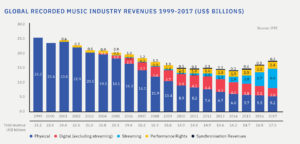
I really like the graph in the Billboard article. It showed where the revenues coming in from and how much from 1997 to 2017. It allowed me to have a better mental picture of where the revenue is coming from. Comparing both articles, I feel like when the industry resists change, they suffer. With the sales of physical declining, the industry should reconsider how artists are being paid by streaming.
https://www.virgin.com/music/should-artist-royalties-from-streaming-be-fairer
I was fortunate enough to speak with Miles Mills, better known by his stage name, Skizzy Mars, a year ago in San Antonio. He is a singer/songwriter and entrepreneur in the music industry. I saw him eating at Fogo De Chao in Downtown San Antonio, and asked him a few questions I have always had for artists of his tier.
One of the questions I asked him, was how much he actually made when I played his music on my smartphone. He replied with gems that included the way the industry is much different than it appears. He then revealed to me that he “don’t make shit” off of music streams. He said he would rather people just burn his music illegally than to put money in the pockets of these major label corporations. He stressed how investing was the most important move before becoming something in this industry. I’ll never forget when he told me that most of his current financial earnings were due to hard work put in prior to his discovery and mainstream break. He basically said, “This is something you do for the love of the craft. But buy my mixtape.” I thought the conversation was quite relaxed and informative. I got to speak to someone who deals with labels first hand, and learned quite a bit.
Here is a link which breaks down an “average” salary for rap artists. I love this article because it’s very eye-opening.
https://bizfluent.com/info-7759411-average-salary-rap-artist.html
In these articles a point is made about how artists don’t get enough credit basically for the work they do making music since the internet is so free flowing with information and such. Artists started doing “music giveaways” to make it a point that we shouldn’t expect free music which I completely agree with because it takes so much time and effort for them to make these songs, writing, recording, etc. It’s crazy to think about how artists are basically forced to sign record deals because they don’t have the ground base to bring their names into the light, but these record labels take almost everything from them, leaving them with little to nothing. The first article mentions how Spotify pays between $0.006 and $0.0084 per stream, but majority of the payment goes to the label, not even the artist. Thinking about it these artists are basically signing their life away to work for these people that tell them how to dress, what to sing, where to travel for tours, etc. and it gets really hard on them, that’s why most artists fall out of the industry tattered and worn out. It’s in their best interest to be like iconic figures such as Chance The Rapper and not even sign a record label because they will ring them for everything they’ve got.
This article talks about how he is an independent artist who just made Grammy history, it is worth it though it does take a while to get their names out there when being independent artists. https://www.independent.co.uk/life-style/chance-the-rapper-grammys-record-deal-a7578031.html
I found the question of “how much is music really worth”, presented by the first article to be extremely interesting thing to consider. Like the article pointed out, a lot of artist revenue that used to be collected through CDs or record sale are now being taken over by steaming services. This is overall hurting the artist as far as sales but as the article also mention, live performances are more popular than ever. So to answer the question, I think the new value of music is representative of experience. Sure people can buy records or CDs and have physical copies but its so much easier and cheaper to stream them and use that money to buy a concert ticket or a festival pass instead. Music will forever be valuable but the way we view that value is ever changing.
In the article I found, it explains why festivals are becoming so popular and how music and live performance is evolving as generational interests change.
Article: https://www.digitalmusicnews.com/2016/07/28/festivals-more-popular/
While reading the first article ” How much is Music really worth?”, I read through a few different sections that reiterated how little revenue artists are able to make on the records they release. What interested me the most was the trend of artists simply not making enough revenue on the albums they’ve released even as technology advanced, or as other media playing devices were invented to make music more accessible.
The article continues to expand upon this idea further and explains how the value of music is determined through a sort of community consensus. Whether it be emotional or monetary value, it still is determined as some sort of value through the perspective of the musical community.
Here is a Forbes Article that explains a few different issues on the value of music in the Music Industry.
https://www.forbes.com/sites/hughmcintyre/2015/08/30/the-music-industry-has-a-huge-problem-with-perceived-value/
The first and second article had very contradicting views. The first talked about how the streaming might be hurting the music industry. and the second about how the industry has grown due to streaming. I think it boils down to this fact that was stated in the first article. “Spotify pays less than a penny for each play of each song.” That tells me two things, that more people have the ability to access music but musicians are getting paid less overall for there craft.
The attached article touches on a little of what each article was speaking on in regards to streaming and the record industry
https://www.cnbc.com/2015/11/04/does-spotify-hurt-the-music-industry.html
What both of these articles have in common is the realization of change that has been brought on by the digital innovations within the music industry. They both attribute these digital innovations to making defining a songs value more cloudy, but at the same time they attribute it to an increase of broad music revenue. It seems the measurement (units) that we have previously used for defining a songs value is obsolete, mainly because of streaming services and the differences in revenue that each service can or does provide. I believe/agree that these streaming innovations have been a savior to the music industry. However, in order to maximize its potential, the music industry needs to get to work on creating a new system that can better deal with and measure digital sales. Without this, there may be untapped profit or unmeasured profit that can be used to reinforce music industry revenue/make people realize the musics value.
The article i have linked below relates to the digital industries problems in obtaining valuable data:
https://www.forbes.com/sites/billrosenblatt/2017/06/03/spotify-lawsuit-settlement-aims-at-solving-music-industry-data-problems/#689ebfcd204a
I’m consistently surprised, and subsequently becoming less shocked by exposure, that the amount of revenue generated is going to the everyone but the Artist. By placing a value onto the music industry, or really a per song payment approach, the income created by it is still filtering to the top executives and not the musicians. Even big names are subject to oversight, which is evident by Robin Thicke and Pharrel’s court loss to Marvin Gaye for rights. But again, this money goes to the top tier personnel. The approach of bands in the past is no longer viable, what makes the artist money is simply the live performances.
After reading both articles they each have some truth to them. As for in “How Much Is Music Really Worth?” streaming free music may be good for the listener but not necessarily the artist. The artists should get money when people listen to their work plain and simple. This also goes back to the Napster days when people downloaded music illegally. Artist were not happy about people getting their work for free, as no one would be. Now streaming music is just another way people do it but legally which is why some artist don’t let their albums on Apple Music or Spotify; you must buy them to listen to their songs. Although streaming music for free isn’t going anywhere soon only expanding. here is an article talking about how Spotify is planning on creating another version of a free music service.
You can find the article here: https://www.bloomberg.com/news/articles/2018-04-10/spotify-is-said-to-plan-new-version-of-free-music-service